
An Editorial Review Workflow for AI Rewrite Variants on X
Use a repeatable editorial checklist to compare AI rewrite variants for X posts without losing the original point or voice.
An Editorial Review Workflow for AI Rewrite Variants on X
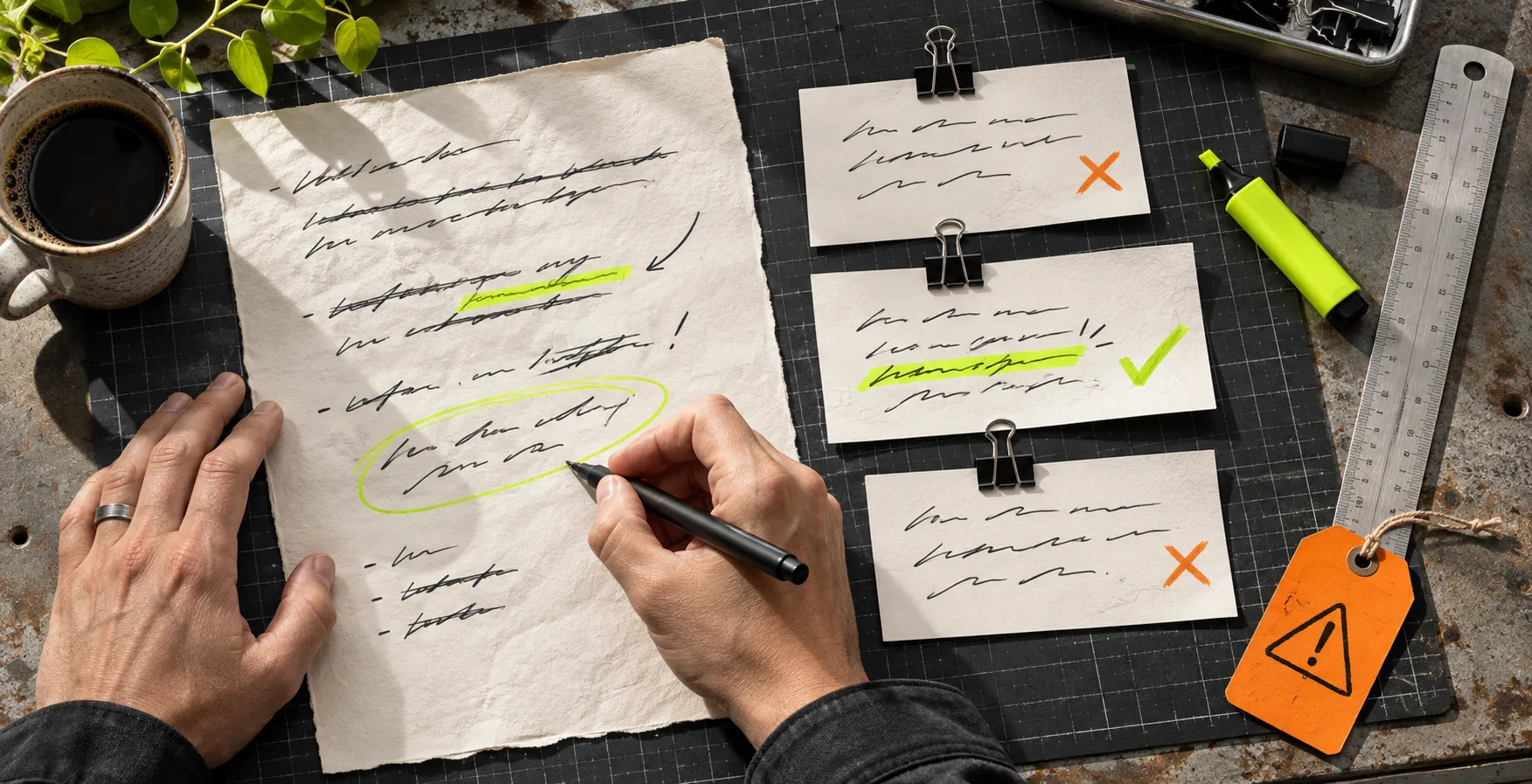
AI rewrite variants are useful only when you can explain why one is better for this post. The practical answer is to start with a short source note, ask for genuinely different angles, then choose against a fixed checklist: accuracy, one clear reader takeaway, a concrete detail, recognizable voice, and a credible invitation to reply.
That makes an AI post improver a drafting bench—not a button that decides what you believe. Beastify is built for that middle step: it diagnoses a draft across hook, clarity, specificity, curiosity, personality, and conversation, then offers several rewrite strategies. Its own site is careful that those scores are editorial heuristics, not predictions. Keep that distinction.
The workflow below works with a notebook and a colleague just as well as it does with a tool. The tool earns its place when it makes the alternatives easier to inspect.
Start with a source note, not a prompt for a post
A weak input produces a tasteful version of the same vagueness. Before requesting variants, write a source note with five fields:
| Field | What to write |
|---|---|
| Reader | The person who should care now |
| Change | What actually changed |
| Evidence | One checkable detail, constraint, or example |
| Point | The one useful conclusion |
| Boundary | What you cannot honestly claim |
For example, a founder might begin with: “Support teams can now attach the original error trace to an escalation. This cuts the back-and-forth when reproducing a bug; it does not fix the bug for them.” That is more useful material than “We shipped a big support update.”
The boundary is not legal padding. It prevents a rewrite from drifting into an inflated promise. It also keeps the social post focused on one job. That is the same discipline behind turning a support pattern into a useful X post: start with a real situation, then surface the lesson.

Ask for angles with different editorial jobs
Do not ask for “five better versions.” You will often get five cousins: same claim, new adjectives. Instead, request variations that make distinct promises to the reader:
- Problem-first: name the friction the update removes.
- Decision-first: explain the trade-off that led to the change.
- Evidence-first: lead with the concrete observation or constraint.
- Conversation-first: end with a real question another practitioner can answer.
Beastify’s documented improve flow returns three or four strategies, which is the right order of magnitude for a human comparison. If you are wiring this into a team tool, its API documentation describes an /improve endpoint, server-side bearer-key authentication, and an optional meme: "auto" setting. Keep the key on the server, and keep final approval with the person accountable for the claim.
Here is a compact request brief you can reuse:
Rewrite this source note in three distinct angles: problem-first, decision-first, and evidence-first. Preserve the stated boundary. Do not add metrics, customer results, or certainty that are not in the source note. Keep the language plain enough to understand in one read.
This is also why a post improver is a better fit than a post generator for this task. You have supplied the raw material and the constraints. The variants are there to expose choices, not manufacture a point of view.
Compare variants with a five-minute review card
Put the source note beside the variants. Then score each one with a simple pass / revise / reject decision—not a fake precision score.
| Check | Pass when… | Red flag |
|---|---|---|
| Accurate | It says only what the source note supports | A new result, number, or guarantee appears |
| Singular | A reader can repeat the one takeaway | It announces features, culture, and a question at once |
| Specific | It contains a real scene, constraint, or example | “Better,” “huge,” and “game-changing” do all the work |
| In voice | You would say it aloud to the intended reader | It sounds like a generic growth template |
| Conversational | The ending opens a relevant exchange | It begs for engagement or manufactures conflict |

One variant may have the sharpest hook and still fail because it implies a result you cannot support. Another may sound polished but erase the odd phrase that makes the writer recognizable. Reject both. The best draft is the one that preserves the evidence while lowering the effort required to understand it.
If several people review posts, save the chosen draft with a one-line reason: “Kept the decision-first version because it names the constraint without claiming a support-volume reduction.” That small receipt makes the next review faster and gives the team a shared standard. It pairs naturally with an AI rewrite review step before publishing an X update.
Treat a meme as an optional clarification test
A meme is not the reward for reaching the end of the editing workflow. Use one only if the text works without it and the image adds a familiar contrast faster than prose can.
Run this three-question test:
- Would a reader understand the point if the image failed to load?
- Does the visual sharpen the same situation rather than start a second joke?
- Would you still be comfortable with the caption next to a customer, partner, or future employer?
If any answer is no, skip it. Beastify’s meme studio can search templates and reaction GIFs, but a larger library does not make a weak association stronger. The useful comparison is not “will this get attention?” but “does this remove explanation without changing the meaning?” For a deeper version of that call, see when a meme helps a product post—and when to leave it out.

Ship the idea, then keep the receipt
Before posting, read the final version aloud once. Check every link, number, named customer, image, and joke. Then save three things: the source note, the selected version, and the rejection reason for the nearest runner-up. That is enough to make your next draft review less subjective without turning social writing into a committee process.
Try the process on one upcoming launch or lesson. Paste the source note into Beastify, request three editorially different angles, and make the selection against the review card—not the variant that merely sounds the most polished. A clear, bounded post that sounds like its author is more durable than a clever rewrite that nobody can defend.