
How to Turn a Product Update Into One Useful X Post
Turn a crowded product update into one useful X post with a reader, proof, and question—then review AI rewrites without losing your judgment.

The quickest way to make a product update useful on X is to choose one reader problem, support it with one concrete proof, and close with one honest question. Do not try to announce every change at once. A shorter post with a clear point gives people something they can understand and respond to.
That sounds obvious, but release notes tend to arrive as a pile: a feature, a bug fix, a new integration, a pricing note, and a team milestone. Publishing that pile as a single post produces a list, not a reason to care. If you need the source material first, turn the changelog into a clear X post before you start polishing sentences.
The three-card method
Before drafting, make three small cards. They are a constraint, not a content template.
- Reader problem: Name the frustrating moment your update changes. “Support requests get lost between inboxes” is better than “new routing rules.”
- Proof: Add one detail that makes the claim inspectable: the behavior, a bounded before/after, a screenshot, or a limit. Do not invent a metric because a metric sounds persuasive.
- Question: Ask something a real practitioner could answer from experience. “What is the one routing rule you always wish you had?” is more useful than “Thoughts?”

Here is a deliberately plain example:
We changed ticket routing because a support lead told us the same customer issue could land in three queues.
Now rules can route by product area before an agent opens the ticket.
Which routing condition causes the most cleanup in your queue?
It has a scene, a specific change, and an invitation that is about the reader’s work. It does not claim to have transformed support, and it does not need a thread to explain itself.
Remove the cards that do not serve this post
This is the hard part. Your release may contain six worthy details, but they are rarely one post. Keep a parking lot for the rest and give each item its own reader problem later. The same discipline is useful when you are building a launch-video evidence pack: source material is not automatically a story.
A practical removal test is: Would the post still make sense if this sentence disappeared? If yes, cut it or save it. Secondary features, roadmap hints, celebratory adjectives, and team credits are the usual suspects.
| Keep | Park for another post |
|---|---|
| The one change that resolves the chosen reader problem | A second feature with a different audience |
| A checkable detail or bounded example | “Game-changing,” “huge,” or unverified outcomes |
| A question someone can answer honestly | A generic request for likes or reposts |
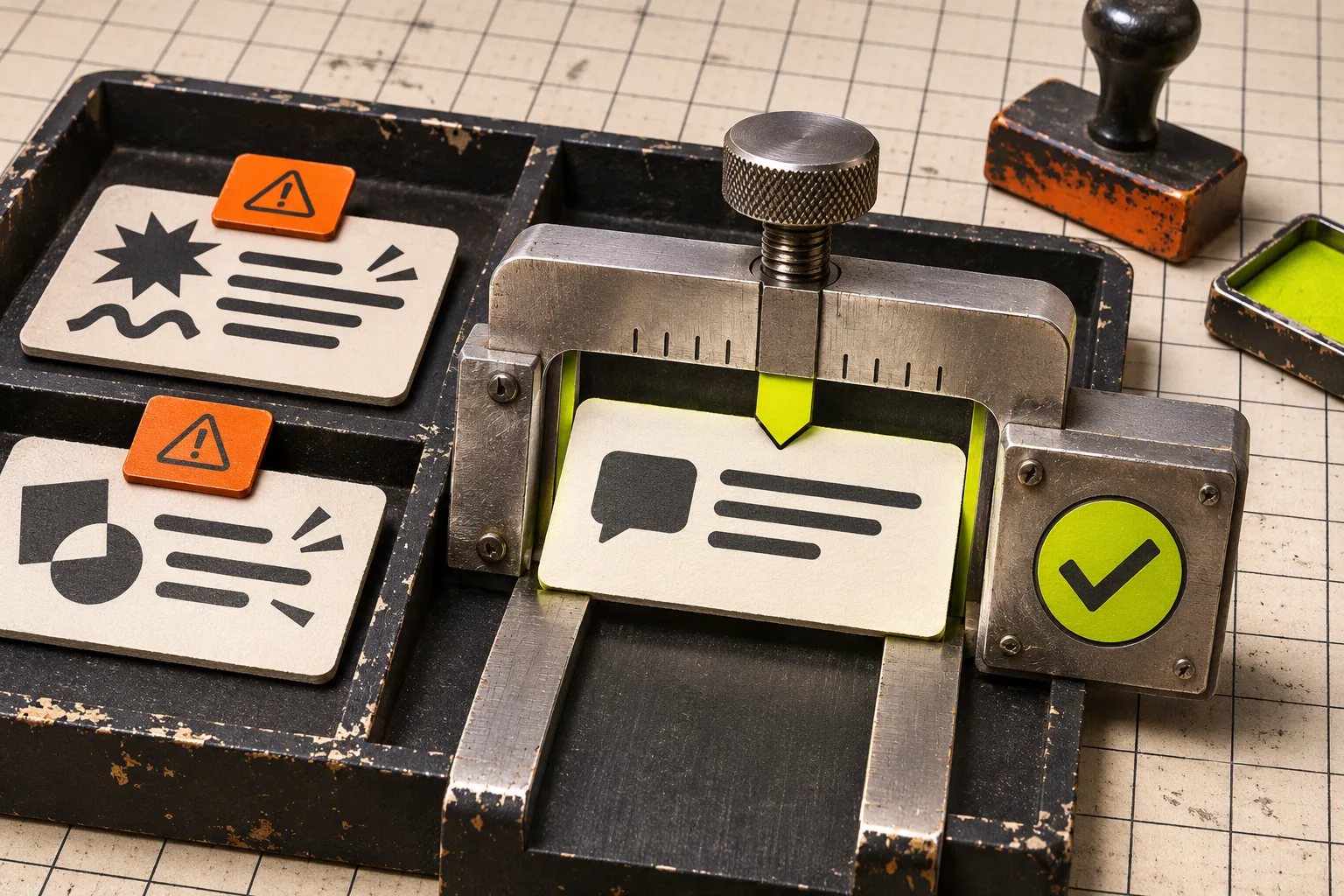
Use AI rewrites as an editing tray, not an autoposter
Once the draft has a point, an improver can be useful for seeing alternate openings. Beastify analyzes a rough X post across hook, clarity, specificity, curiosity, personality, and conversation, then returns several rewrite strategies. Its documentation describes these scores as editorial feedback; they are not predictions of reach.
Paste the three-card draft, not the full release note. Then compare the variants against the cards:
- Does the first line preserve the reader problem?
- Did a rewrite remove the only proof?
- Does the tone still sound like someone on your team would say it?
- Is the question a genuine invitation, or engagement-shaped filler?
If a variant is sharper but makes a broader promise, borrow the sentence structure rather than publishing it unchanged. That is also the human-control rule in this editorial workflow for AI rewrite variants.
Run a final approval gate
Give the final draft a 60-second check before it ships:
- Can a busy reader name the problem after the first sentence?
- Is every factual claim something you can stand behind today?
- Does the example reveal enough context without exposing a customer?
- Would the post still be useful with no product link attached?
- Is the question safe to answer in public and worth answering?
If the post fails any of these, return to the three cards. This small gate is more reliable than adding a cleverer hook. It also keeps a social workflow from becoming a blind content factory.
Learn from understanding, not vanity signals
After publishing, look for evidence that people understood the point: replies that use the same problem in their own words, questions that reveal a useful ambiguity, or a follow-up conversation with a real operator. Save that observation beside the original three cards.

Do not turn that review into a dashboard ritual. A few likes do not validate a claim, and a quiet post can still be a clear record for the right customer. The useful outcome is a better next draft. If you need a more structured team pass, this four-card ecommerce post review is a good extension.
Your next update needs one job
Pick the product change with the clearest reader consequence. Write its three cards, draft the post, and use Beastify only to inspect options—not to surrender the decision. Publish the version that keeps the problem, proof, and honest question intact. The other updates can wait for their own useful post.